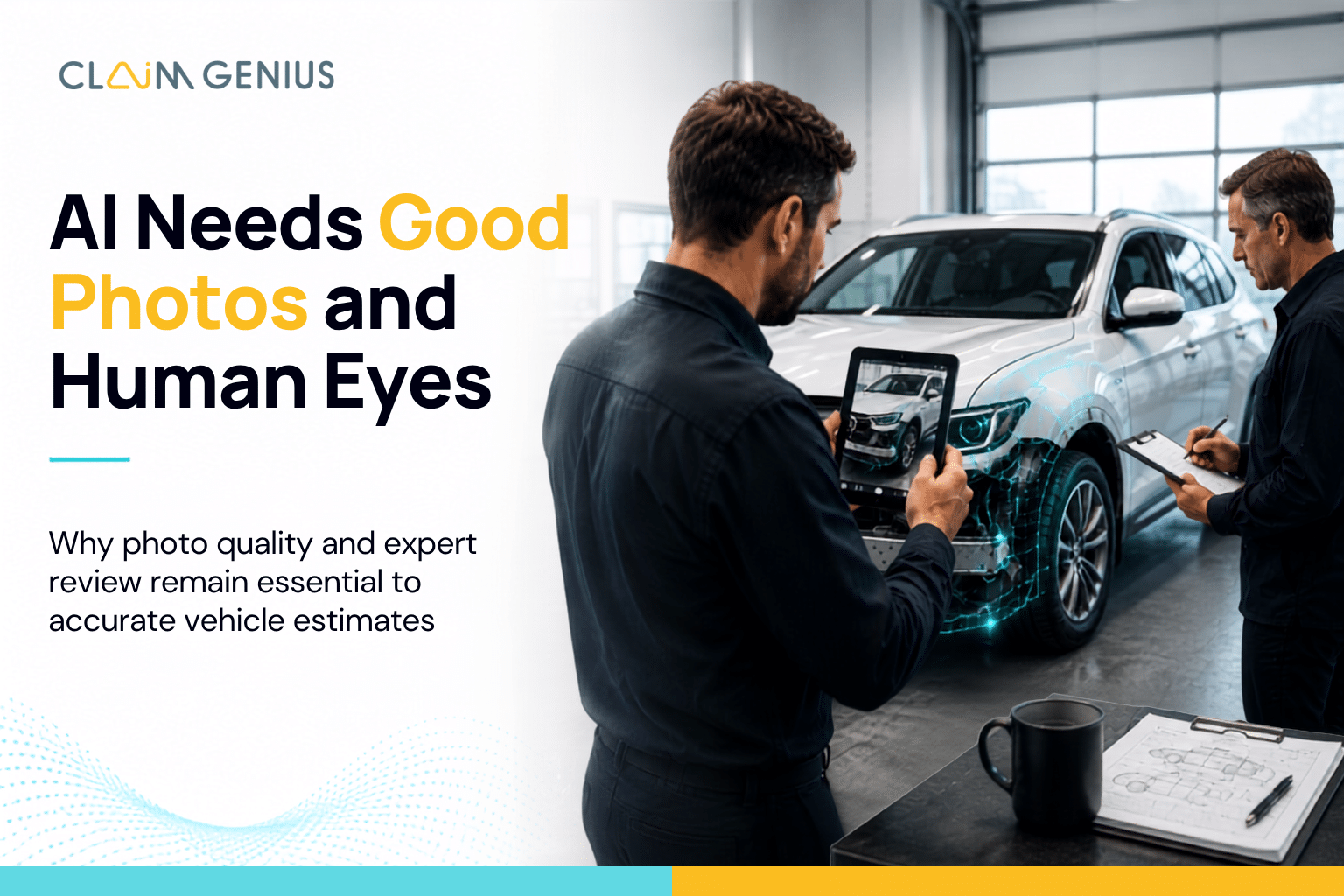

CIC panelists discuss how photo quality and human review shape the accuracy of AI-based estimating tools.
If you haven’t been too impressed with the photo estimating systems you’ve used or encountered to date, Scott VanHulle of I-CAR says give it a little more time. Think back to the early days of texting if you’re old enough, he suggests.
“Remember when in order to type a ‘c,’ you had to hit a button three times,” VanHulle, chairman of the Collision Industry Conference (CIC) “Emerging Technologies Committee” said at this past spring’s CIC. “Right now, we’re at that kind of stage with photo estimating and AI. It is the very beginning. It’s going to continue to evolve. And the problems we have today, if we keep working on them, it’s going to get better. Technology is going to continue to grow, and we can either yell and scream about it and do nothing — or we can work to see how we can help make it better and help improve it for the entire industry.”
VanHulle asked representatives of two companies offering photo estimating systems to talk about the strengths — and weaknesses — of the systems as they exist today, as well as how they foresee them evolving.
Two companies weigh in on productivity gains
Raj Pofale, CEO of Claim Genius said his company’s AI-based estimating tool is in use in about 300 shops, and he sees it as a productivity tool.
“What they are looking for is how my service advisor can get the estimate done quicker,” Pofale said. “What the customer feedback is telling us is they are saving approximately 30 to 35 minutes on each estimate. Yes, there are some gaps in those estimates. They are just a preliminary, initial estimate. But if they are saving 30 minutes on average on one estimate, you can see how many hours they’re saving throughout the day.”

Mark Fincher of CCC Intelligent Solutions said he sees his company’s “Mobile Jumpstart” product offering shops a way to improve the initial time spent with a potential customer. A customer sitting in the shop lobby waiting 20 or 30 minutes for an estimate can be replaced with an initial Jumpstart estimate created in about 70 seconds that captures 84 percent of what’s on the final bill. Some may quibble with those numbers, but Fincher said his point is the system enables better interaction with that customer rather than them waiting much longer for an estimate.
“We talk about the importance of quality repairs, using the OEM procedures, and this gives you the opportunity to engage that customer and explain that while you’re at the car,” Fincher said. “You’re not going to have that opportunity if you’re sitting behind a desk inside the shop with the customer sitting in the lobby.”
Where the technology still falls short
VanHulle asked what the systems are likely to miss.
“There will be always a gap. It’s not going to be 100 percent complete,” Pofale acknowledged, noting that the system can identify some but not all structural damage, and internal parts damage won’t be picked up. “Those are the kind of things where a human would need to look at it. It’s a myth saying that this is going to replace the humans out in the industry. It’s not. These are the gaps that the technology is having today, and that’s where a human is required.”
Fincher agreed.
“It’s getting better and better, and the models will continue to improve, but the AI is not going to guess: Is that rear body panel damage? Is that suspension damaged,” he said. “We can’t see it. We’re not going to have it guess. It can use historical information, historical estimates to make predictions on what it can see, but it’s not going to guess about things that it can’t see. So absolutely that’s why it’s still key that we have the human in the loop, and that we do the full disassembly blueprint of the vehicle as part of our process.”
Photo quality drives estimate accuracy
VanHulle said he’s still surprised by some of the poor quality photos he’s seen from shops given how good cell phone cameras have become. Does that impact AI-powered photo estimate quality, he asked Fincher and Pofale.
“Absolutely. Garbage in, garbage out,” Pofale said. “The better the photo quality is, the better the results are. If the resolution is good, you can literally go to a tiny dot on the car and say, ‘This is a paint repair job because of this scratch. It’s not that the technology can do wonders. The technology can do wonders only when you feed in good data.”
Fincher said he had an opportunity to visit a shop that is pre-washing vehicles prior to blueprinting repairs to remove dirt or debris on the vehicle.
“AI can benefit from the same process, making sure that the vehicle is clean, especially in areas where there’s snow or mud, especially in the winter time,” Fincher said. “Proper lighting and having a consistent set of images…can help the AI just be that much more accurate.”
He said a user might think a close-up shot of a panel will best show the damage, but that’s not always the case.
“They get two inches away from the damage, but then it just looks like a blob,” Fincher said. “In their mind it’s, ‘Hey, I’m showing you what the damage is,’ but we don’t have context. Context for the AI is really important so it can detect exactly what it’s looking at, what area of the vehicle, what parts are impacted.”