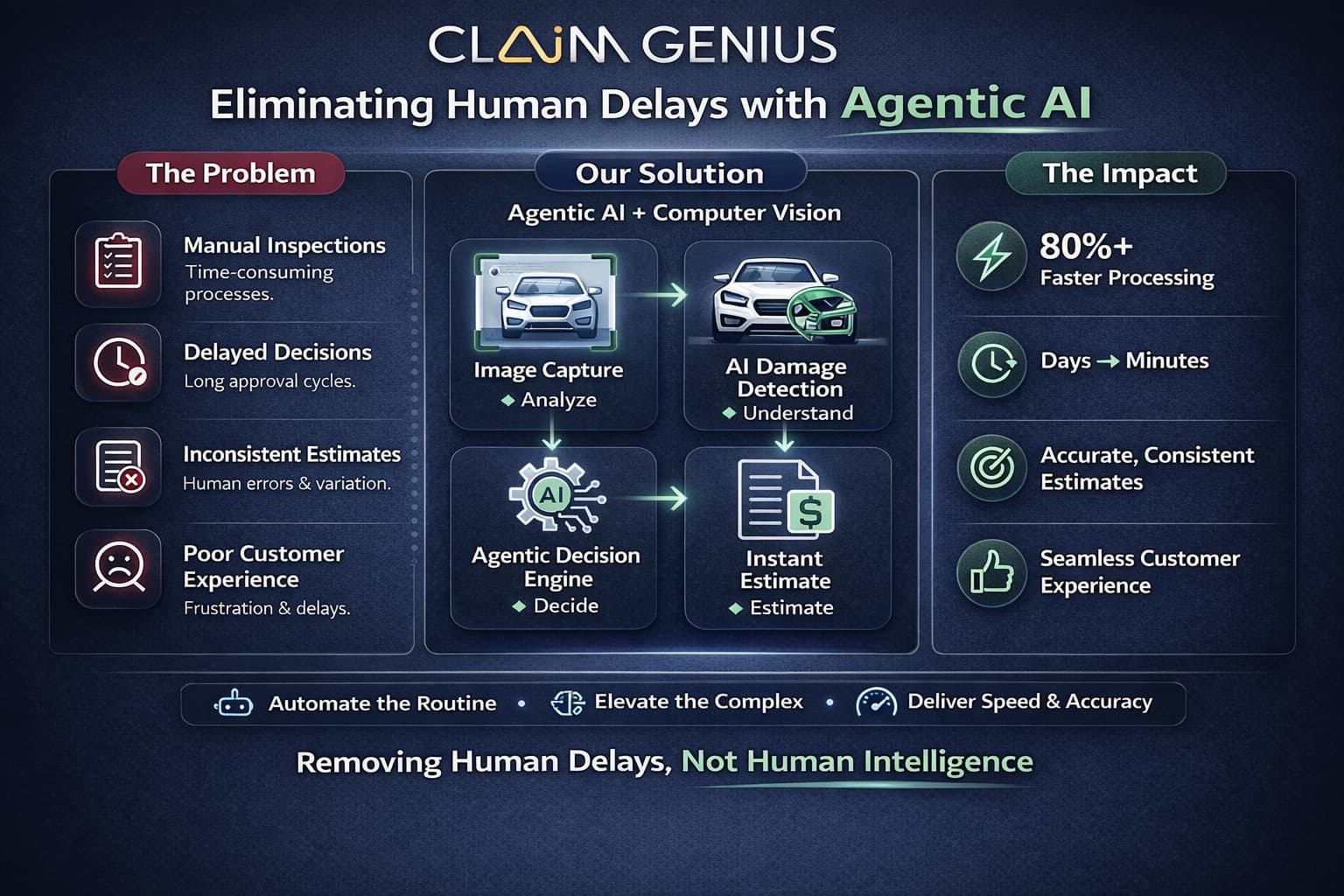
Transforming Motor Insurance Through Intelligent Automation
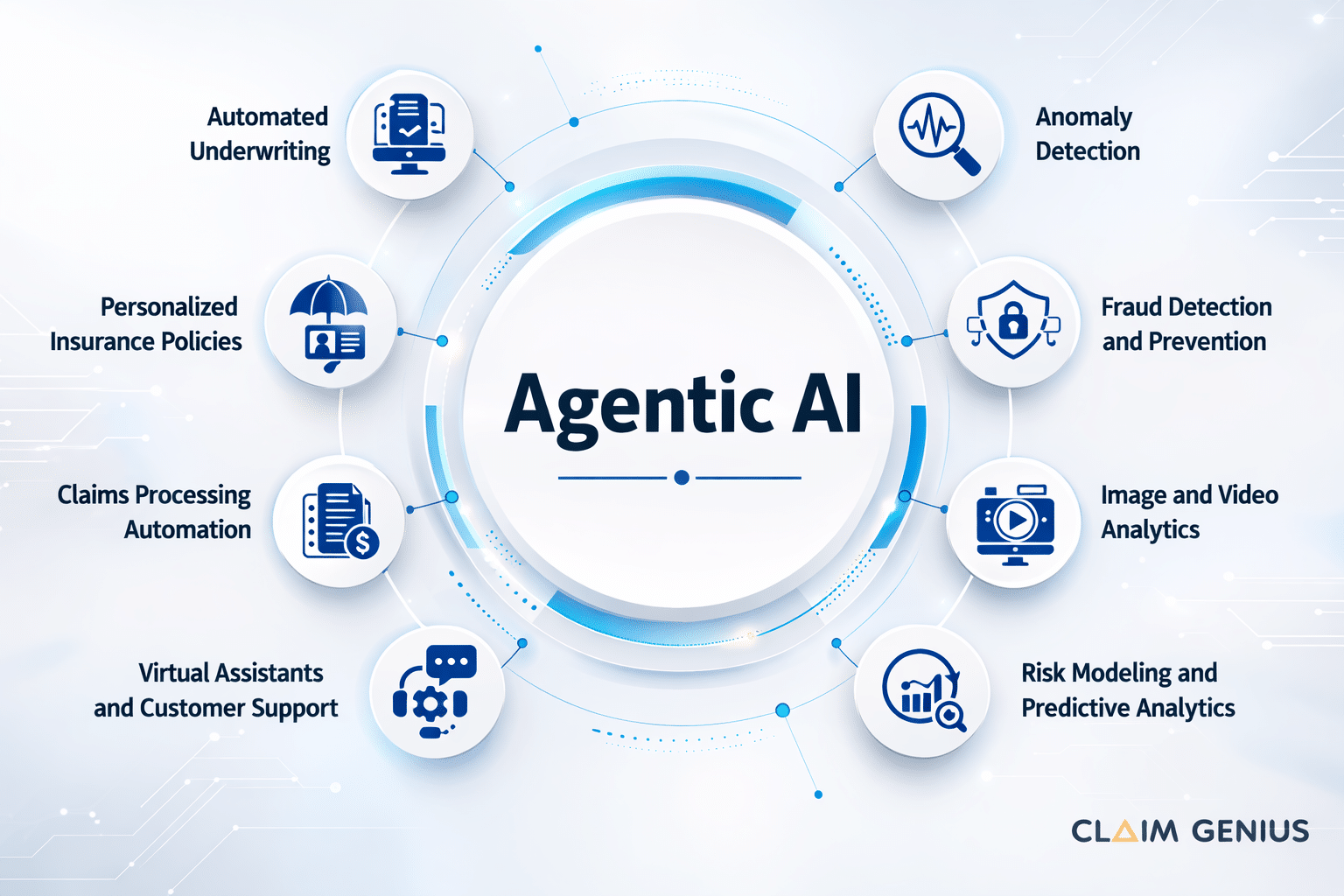
The motor insurance sector is currently experiencing a paradigm shift, and pre-inspection is right at the center of this revolution. In the past, pre-inspection, which is essentially the evaluation of a vehicle’s condition before the issuance or renewal of a comprehensive insurance policy, was largely dependent on manual surveyor inspections. These inspections were not only time-consuming and expensive but also prone to errors and fraud. However, the advent of Agentic AI, computer vision, and large language models is currently breaking all the rules and making it possible to conduct vehicle inspections faster, more accurately, and in a truly customer-centric manner.
This blog will delve into the world of agentic AI and its applications in pre-inspection within the motor insurance sector.
My neighbor bought a new car last year. Second-hand, actually a three-year-old sedan he’d saved up for over eighteen months. The day he drove it home, he was beaming. Couldn’t stop talking about the mileage, the sound system, and the way it handled on the highway.
Two days later, he called me, sounding completely deflated.
“They’re sending someone for inspection,” he said. “Could be Thursday. Could be next week. They’ll let me know.”
He waited nine days. The surveyor came, walked around the car, took some photos, asked a few questions, and left. Another week passed before the policy came through. By that point, the excitement of buying the car had faded into something closer to exhaustion.
“I just wanted insurance,” he told me. “I didn’t sign up for all this.”
He’s not a difficult person. He’s not impatient. He just wanted the process to match the experience he was used to in every other part of his life, fast, clear, and designed around him rather than around the system.
That gap between what customers expect and what the insurance industry has traditionally delivered, that’s the gap that Agentic AI is now closing.
From Minutes to Seconds: How Agentic AI is Changing the Way We Handle Windshield Claims
If you’ve ever filed an insurance claim, you know the drill — hurry up and wait. In auto insurance, especially, speed matters enormously. A customer who gets a fast, hassle-free resolution walks away satisfied. One who waits days for a simple windshield claim? They start shopping for a new insurer.
And yet, for years, windshield claims — the single most common type of auto insurance claim — have been stuck in exactly that slow lane.
It’s a little surprising when you think about it. These are relatively simple claims. No injuries, no liability disputes, no complicated investigations. Just a cracked windshield and a straightforward repair. But the traditional process still chewed up 15 to 30 minutes of active human labor per claim. Staff had to sort through physical documents, squint at low-resolution photos, manually key in data, and cross-reference pricing tables — all for something that should, in theory, be quick and clean.
Introducing Intelligent Loss Assessment — Rebuilt From the Ground Up
We set out to ask a simple question: what would this process look like if we designed it from scratch today, with no legacy constraints?
The answer became our Intelligent Loss Assessment (ILA) system. This Agentic AI platform doesn’t just assist humans with claims processing; it handles the entire workflow autonomously, from the moment a customer submits their first photo to the moment the claim is ready for adjudication.
The result? What used to take half an hour now takes under three minutes.
The Old Way vs. The New Way
| Before | After | |
|---|---|---|
| Processing time | 15–30 minutes | Under 3–4 minutes |
| Document handling | Manual sorting & OCR entry | Automated classification & field extraction |
| Pricing | Human-assisted price mapping | AI-driven parts & pricing logic |
| Missing documents | Days of waiting | Real-time WhatsApp/SMS alerts |
But the numbers only tell part of the story. The bigger shift is in how the work actually gets done
How It Actually Works
The word “Agentic” is important here. This isn’t a chatbot following a decision tree. It’s a system that reads context, makes judgments, and adapts — much like an experienced human adjuster would, but faster and without fatigue.
Here’s what happens behind the scenes:
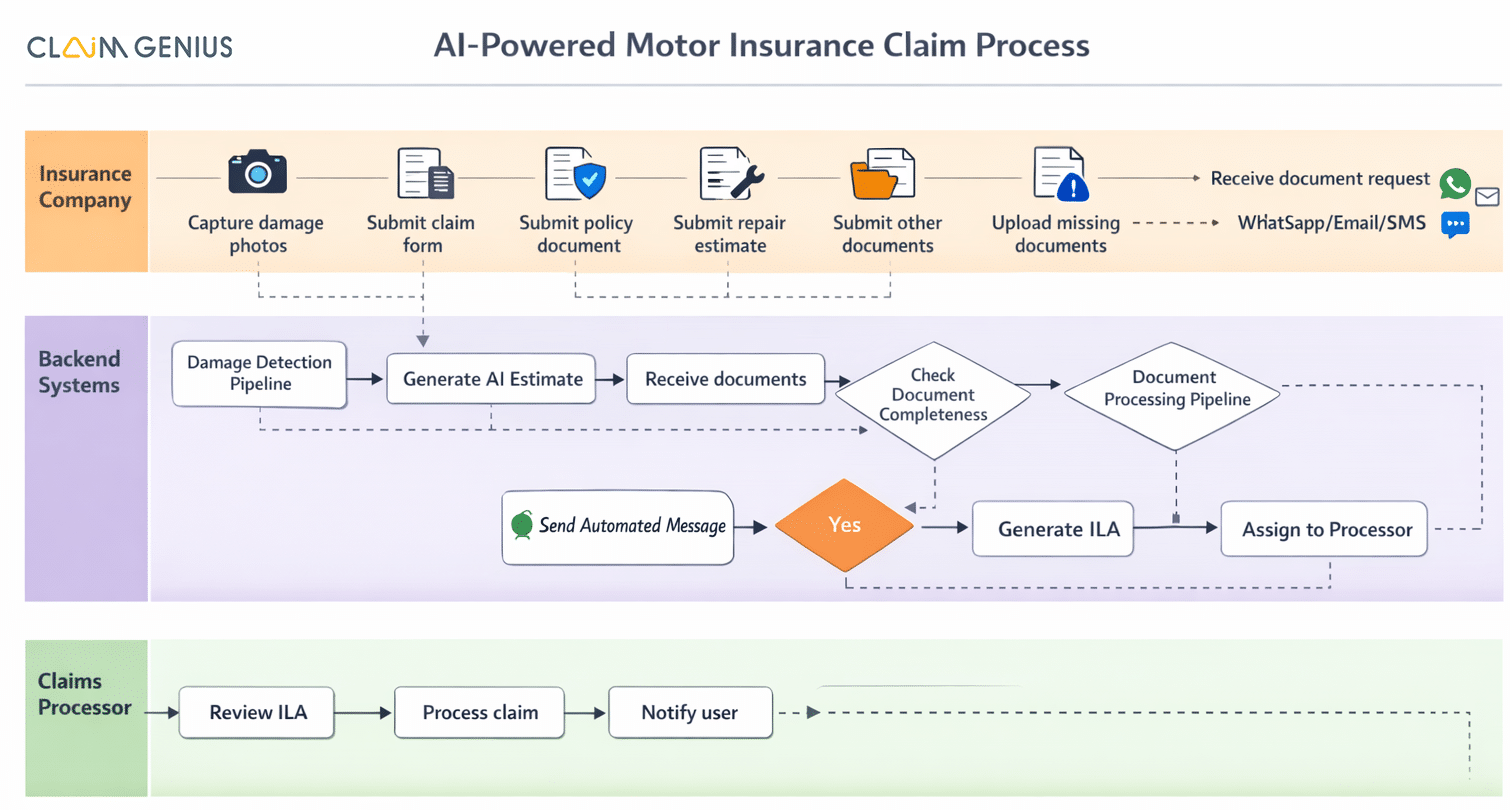
How the Magic Happens: Under the Hood
The “Agentic” part of our AI means the system doesn’t just follow a script; it makes decisions based on the data it receives. Here is the step-by-step breakdown of the automated pipeline:
1. Smart Intake & Gap Analysis
The process starts with the customer. As soon as damage photos and claim documents (policies, invoices, estimates) are uploaded, the AI performs a “sanity check.” If a document is missing or blurry, the system automatically triggers a notification via WhatsApp, email, or SMS to the customer. No more waiting days for a human to realize a file is missing.
2. Parallel Intelligence Tracks
Once the file is complete, the AI kicks off two simultaneous processes:
- The Damage Detection Pipeline: Analyzes photos to create a visual estimate of the impact.
- The Document Processing Pipeline: Uses intelligent OCR to classify documents and extract structured data from invoices and policies.
3. The Agentic Coordination Layer
This is the “brain.” The AI agent reviews the extracted data to ensure it’s a windshield-only claim. It maps parts, verifies pricing logic, and checks confidence thresholds.
- Straight-Through Processing: If everything matches, the ILA is generated instantly.
- Human-in-the-Loop: If the claim is complex or falls outside the windshield scope, the agent flags it for a human expert, ensuring no errors slip through.
The Results: 80% Faster, 100% Consistent
The shift from manual processing to an Agentic workflow has delivered staggering improvements:
- Time Savings: A 75% to 85% reduction in processing time.
- Near Real-Time Readiness: Claims are ready for downstream adjudication almost immediately.
- Consistency: Eliminates “human fatigue” errors in data entry and price mapping.
The Day the Agentic AI Did What the Surveyor Used to
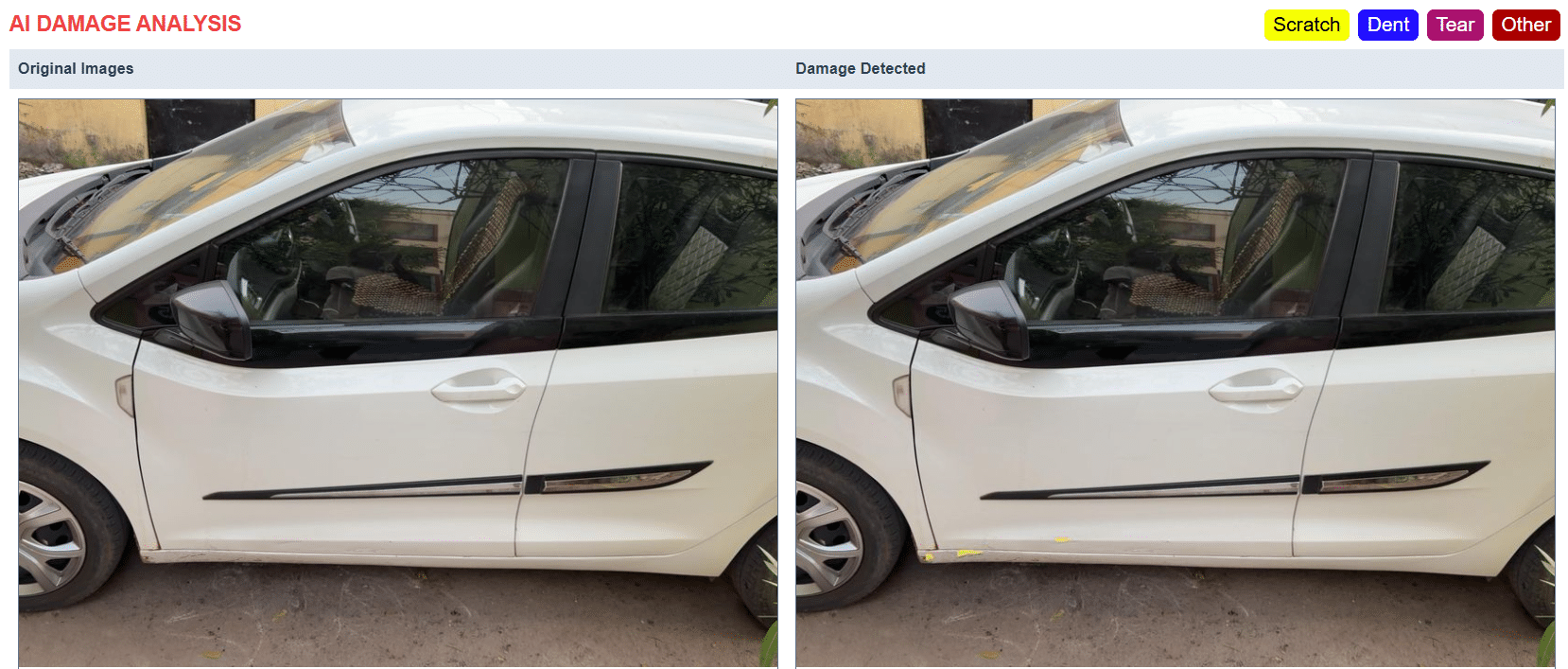
At Claim Genius, we are developing a mobile and web app using computer vision, deep learning, and Agentic AI to detect damage such as dents, scratches, and cracks from images customers take. Surely the images had to go somewhere and sit in a queue?
But no. Here’s what actually happens now, with the better implementations of this technology.
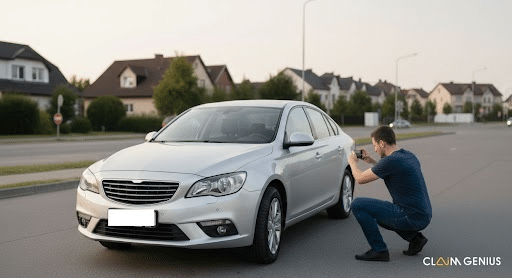
You open the app. It greets you not with a wall of instructions, but with a simple prompt. “Let’s start with the front of your car.” You hold up your phone. The app looks at the image in real time. If the angle is off, it tells you. If the light is poor, it suggests you move. If something is partially obscured, it asks you to adjust.
It’s remarkably patient. More patient, if we’re being fair, than most humans would be.
Once you’re done, and this typically takes somewhere between eight and fifteen minutes, you close the app. No follow-up call. No waiting for a report to be typed up somewhere. The AI has already done the heavy lifting.
It has examined each image against a trained model built on hundreds of thousands of vehicle photographs. It has identified the scratch along the rear quarter panel. It has been noted the small crack near the headlight casing. It has flagged the slight discolouration above the wheel arch that might be early-stage rust or might just be road dirt, and it has marked that for a human to confirm.
By the time you’ve put your phone back in your pocket, there’s a structured inspection report sitting in the insurer’s system, ready for underwriting review.
What the Agentic AI Is Actually Doing Underneath
It’s worth spending a moment on the mechanics, not because the technology is the point, but because understanding it helps explain why the output is trustworthy.
The visual analysis layer doesn’t just look at your photos the way a human would glance at them. It examines each image systematically, panel edges, paint surfaces, glass, trim, wheels, and undercarriage where visible, cross-referencing against an enormous training dataset of vehicles in various conditions. It’s been shown enough examples of subtle door dings, faded paint, cracked windshields, and accident damage that it recognises patterns a tired surveyor at the end of a long day might miss.
Image enhancement means that a slightly blurry photo, or one taken in the shadow of a parking garage, doesn’t automatically get rejected. The system works with what it has, improving clarity where possible, flagging where it genuinely cannot make a confident assessment.
The report generation powered by Agentic AI turns technical findings into human-readable summaries. Not a list of codes. Not an incomprehensible table. Actual sentences that an underwriter can read, understand, and act on.
And the fraud detection layer, arguably the most valuable piece from the insurer’s perspective, looks for inconsistencies that might indicate manipulation. Images that don’t match in terms of lighting conditions. Angles that are subtly inconsistent with the vehicle dimensions. Metadata that doesn’t add up. These get flagged, not acted upon automatically, but surfaced for human review.
The system is not infallible. No system is. But it is consistent in a way that human processes, by their nature, cannot always be.
The Surveyors Didn’t Disappear. They Got Better Jobs.
There’s an uncomfortable question lurking in all of this, and it deserves a direct answer.
If AI can inspect a vehicle in minutes, what happens to the people who used to do that work?
The honest answer, based on what’s actually happened in the insurers that have adopted this approach, is: they moved up.
The straightforward cases, the standard family saloon with minor cosmetic wear, the three-year-old hatchback in good condition, these flow through the automated pipeline without needing human eyes. That’s the majority of cases.
But the complex ones still need people. The heavily modified vehicle. The one with a history of accidents raises questions. The claim involves a subtle discrepancy between what the AI flagged and what the policyholder reported. The edge cases, which in a portfolio of any real size number in the thousands.
These cases used to sit in a queue behind all the routine ones. Now they get immediate attention from people who have the experience and judgment to handle them properly.
The surveyor who used to spend their Tuesday photographing parked cars in a suburb is now doing work that actually requires their expertise. That’s not a bad trade.
The Quiet Revolution in How Customers Feel About Insurance
Insurance companies spend a lot of money measuring customer satisfaction. Net promoter scores. Post-interaction surveys. Renewal rates. Complaint ratios.
What they’re really trying to measure is something more fundamental: do customers trust us? Do they feel like we’re on their side?
And the uncomfortable truth that a lot of insurers have discovered is that the inspection process is one unavoidable friction point that has been doing quite a lot of damage to that trust for years. Not dramatically. Not in a way that shows up in one quarter’s data. But steadily, year after year, every time a customer had to wait for a surveyor and wondered whether the whole thing was really necessary.
Remove that friction, and something shifts.
Customers who complete a self-inspection in ten minutes and receive their policy the same day don’t just become more satisfied. They become more willing to engage. More likely to buy additional coverage. More likely to renew without shopping around.
Trust, it turns out, is partly a function of how much of someone’s time you waste.

Access for People Who Were Always Left Out
There’s another dimension to this that doesn’t get talked about enough.
The traditional surveyor model worked reasonably well in cities. In smaller towns, it worked with some delays. In rural areas, it ranged from inconvenient to genuinely inaccessible.
If you lived two hours from the nearest major city and wanted to buy motor insurance, you were often looking at waits of two weeks or more for an inspection. Some people gave up and bought whatever was available without inspection, which created its own problems. Some simply remained uninsured.
A phone-based inspection changes that equation completely. If you have a smartphone and a reasonable data connection, and increasingly, that’s almost everyone, you can complete your inspection from anywhere. The farmer in a remote district and the executive in a metropolitan apartment tower have the same experience.
That’s not a small thing. That’s a meaningful expansion of access to financial protection for people who have historically been underserved by the industry.
Where This Is All Heading
The current wave of Agentic AI-assisted inspection is impressive. But the people building these systems will tell you, privately, that what exists today is a rough draft.
The next generation will not just assess what a vehicle looks like at a point in time. It will combine that visual snapshot with data from the vehicle’s own systems, such as how it’s being driven, how many kilometres it covers, and what kinds of roads it typically uses. It will layer in historical claims patterns and weather data, and any number of other signals that together paint a much richer picture of actual risk.
And that richer picture enables something that the industry has talked about for years without quite achieving it: genuinely personalised insurance. Not personalised in the sense of slightly different premiums based on age and postcode. Personalised in the sense of coverage and pricing that actually reflects how a specific person uses a specific vehicle.
Beyond pricing, there’s the possibility of prevention. If the data suggests that a particular driver is developing habits that correlate strongly with accident risk, the insurer can reach out. Not to cancel the policy, but to help. A driving tip. A suggestion. A gentle flag.
That reframes the entire relationship between insurer and customer. Not adversarial, you pay, we hope nothing happens, but genuinely collaborative.
Back to Customer Story
He renewed his policy last month. The whole inspection took him about twenty minutes, most of which was spent trying to remember his login credentials.
He didn’t call the insurance provider afterwards. Which, honestly, is the point.
The best version of any process is the one you don’t notice because it just worked. No drama. No waiting. No frustrated phone calls. Just a thing you needed to do, done, and then you went back to your day.
Pre-inspection used to be the part of buying car insurance that stayed with you because of how much it annoyed you. Now, done right, it becomes the part you forget about immediately because it gave you no reason to remember it.
That might sound like a modest ambition for a powerful piece of technology. But in an industry where trust is everything, removing the reasons for frustration is not a small thing.
It is, in fact, the whole thing.